We often imagine toxic people as loud.
They shout in meetings.
They slam doors.
They openly insult colleagues.
They make enemies visible.
Reality is usually quieter.
Some of the most damaging people in organizations never lose their temper. They never use offensive language. They smile. They thank everyone. They call you “dear,” “my friend,” or “great job.” They speak softly enough that everyone mistakes civility for character.
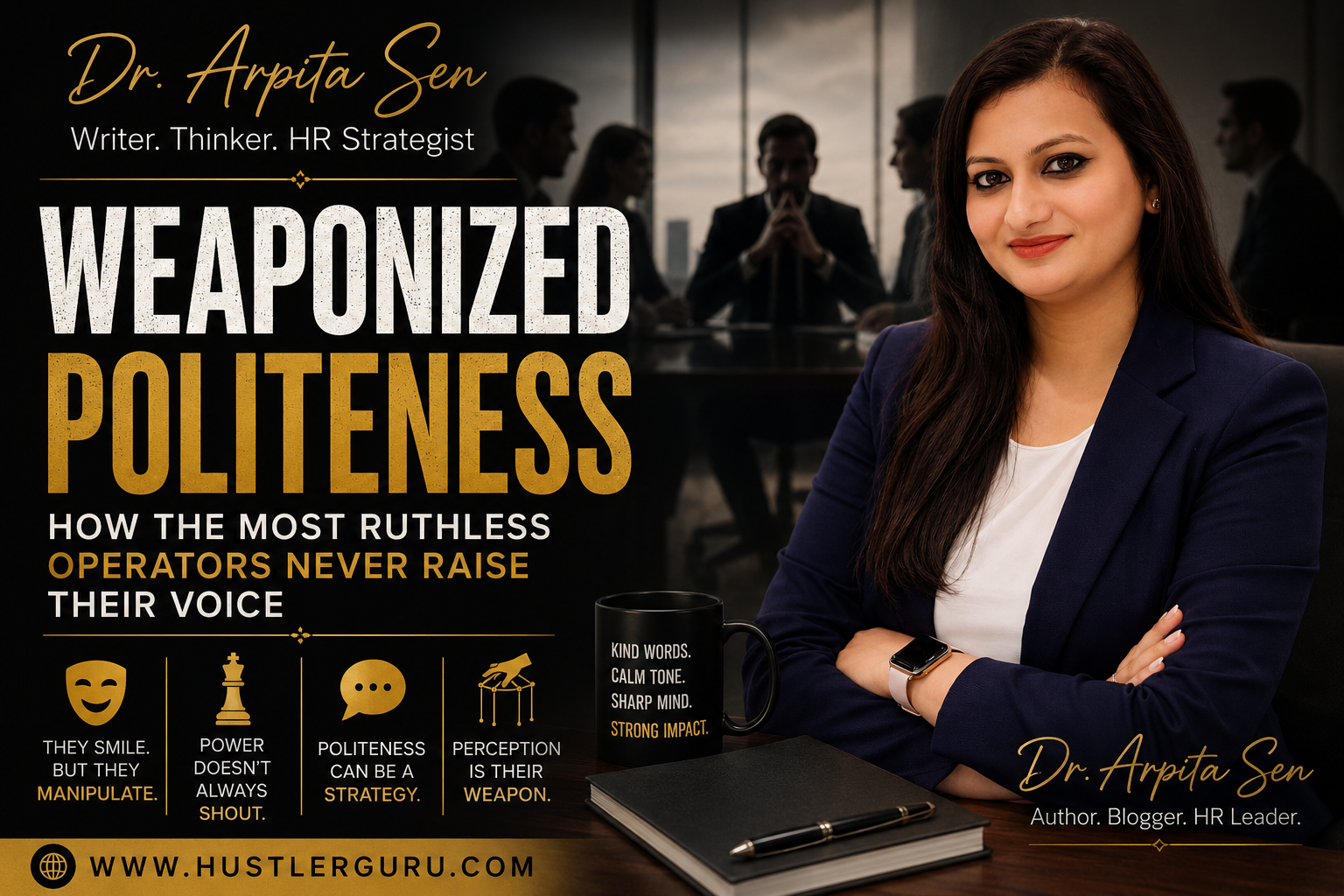
This is weaponized politeness.
It is not kindness.
It is the strategic use of courtesy to exercise power while remaining beyond accountability.
The New Face of Organizational Aggression
Corporate workplaces have evolved.
Open bullying is easier to identify. HR policies, POSH committees, ethics hotlines, and social awareness have made overt aggression increasingly risky.
But power rarely disappears.
It simply changes form.
Instead of shouting, some people now manipulate through excessive politeness.
Instead of attacking your reputation directly, they “express concern.”
Instead of saying no, they “need more alignment.”
Instead of excluding you openly, they “forgot to include you.”
Instead of questioning your competence publicly, they “just have a few clarifications.”
Every sentence appears reasonable.
Every action is individually defensible.
Collectively, they create an environment where one person gradually loses credibility, influence, confidence, and visibility.
Why It Is So Difficult to Prove
The brilliance of weaponized politeness lies in plausible deniability.
Nothing sounds inappropriate in isolation.
“No worries.”
“Just checking.”
“Perhaps we should revisit this.”
“I may be wrong.”
“Let’s hear everyone else’s opinion.”
Each statement appears collaborative.
The manipulation emerges only when viewed as a pattern rather than an event.
Projects are delayed just enough to make you appear slow.
Information reaches everyone except you.
Your ideas are ignored until someone else repeats them.
Your achievements receive polite silence while minor mistakes become topics for careful discussion.
Everything happens without anyone technically breaking a rule.
That is precisely why it works.
Civility Is Not the Same as Integrity
Organizations often reward polished communication.
People who remain calm under pressure are seen as emotionally mature.
That assumption is dangerous.
Professional etiquette measures style.
Integrity measures intent.
Someone can communicate beautifully while systematically undermining colleagues.
Conversely, someone can occasionally sound blunt while acting with complete honesty and fairness.
When organizations mistake diplomacy for ethics, skilled manipulators thrive.
The Psychology Behind Weaponized Politeness
This behavior is rarely impulsive.
It is calculated.
The objective is not to defeat you in one confrontation.
It is to shape how others perceive you over months or even years.
By remaining impeccably polite, the operator creates a powerful contrast.
When you eventually become frustrated, exhausted, or emotional, observers subconsciously compare your visible reaction with their composed demeanor.
The story quietly becomes:
“They always remain calm.”
“You seem defensive.”
The original manipulation disappears.
Only your response remains visible.
This is reputation management disguised as emotional intelligence.
The Cost to Organizations
Many organizations believe they have eliminated workplace politics because meetings are respectful.
Respectful meetings do not necessarily indicate respectful cultures.
Weaponized politeness slows decision-making.
It suppresses innovation because employees become afraid to speak candidly.
It drives away high performers who mistake manipulation for organizational culture.
It rewards impression management over execution.
The financial impact rarely appears in audit reports.
It appears in declining trust, reduced collaboration, hidden attrition, slower innovation, and leadership teams making decisions based on carefully curated narratives instead of reality.
How Leaders Can Recognize It
Instead of asking:
“Did anyone behave rudely?”
Ask different questions.
Who consistently receives incomplete information?
Whose ideas repeatedly require validation from someone else before being accepted?
Who is always described as “difficult,” but consistently delivers results?
Who benefits from prolonged ambiguity?
Which conflicts involve dozens of perfectly polite emails but produce no actual progress?
Politics often leaves process footprints long before it leaves emotional evidence.
Protecting Yourself
The response is not to become equally manipulative.
It is to become exceptionally observant.
Document patterns, not isolated incidents.
Communicate with clarity rather than emotion.
Confirm decisions in writing.
Build credibility across multiple stakeholders rather than relying on one sponsor.
Most importantly, separate courtesy from trust.
Someone’s pleasant tone tells you how they speak.
It tells you very little about how they exercise power.
The Leadership Lesson
Professionalism is valuable.
Politeness is essential.
But neither should become a substitute for character.
The healthiest organizations are not those where nobody disagrees.
They are the ones where disagreement is transparent, accountability is consistent, and kindness is genuine rather than strategic.
Because sometimes the sharpest knife in the boardroom isn’t hidden behind anger.
It’s hidden behind a smile.

Dr. Arpita Sen holds a bachelor’s degree in Dental Surgery (BDS) from YMT Dental College and Hospital, Navi Mumbai. She also holds an MBA in Human Resources from Narsee Monjee Institute of Management Studies (NMIMS), Mumbai, where she graduated as a double gold medallist. She is the co-author of Not a Rat Race: Success Mantras of World Athletes (2023), and Winning as Husband and Wife: Decoding the Success Mantras of Marriage (2026), co-written with Abhirup. She currently leads Learning, Organization Development, DEI, Culture, Talent and HR Strategy at a multinational organization. She writes on growth, leadership, and the future of work in her blogs, mindofhr.com and hustlerguru.com, and has been featured across several speaking platforms, podcasts and panel discussions. In her free time, she enjoys travelling, reading novels, singing and performing classical dance. She can be reached on Instagram at @authorarpitasen and on LinkedIn
Read her books:
Not a Rat Race: Success Mantras of World Atheletes
Winning as Husband and Wife: Decoding the Success Mantras of Marriage