There is a moment most people never talk about.
Not the fall itself. Not the public humiliation, the pink slip, the failed business, the scandal, the diagnosis, the defeat. People talk about those eventually – in interviews, memoirs, and motivational reels carefully edited for inspiration.
The moment I mean is quieter than that.
It is the one that happens after. When the noise dies down. When the calls stop coming. When you are sitting somewhere ordinary — a kitchen table, a hospital corridor, a one-room office that used to be a corner suite and the question arrives without warning.
Now what?
That question is where everything begins. Or ends.
I have been thinking about this for a long time. Not just as someone who studies human behavior and organizations. But as someone who has lived versions of it. I have watched careers collapse around me. I have seen people I admired disappear quietly from rooms they used to command. And I have watched others – unexpected ones, unlikely ones – somehow find their way back. Stronger. Clearer. More themselves than before.
What separates them is not luck. It is not connections, though those help. It is not even talent, though that matters.
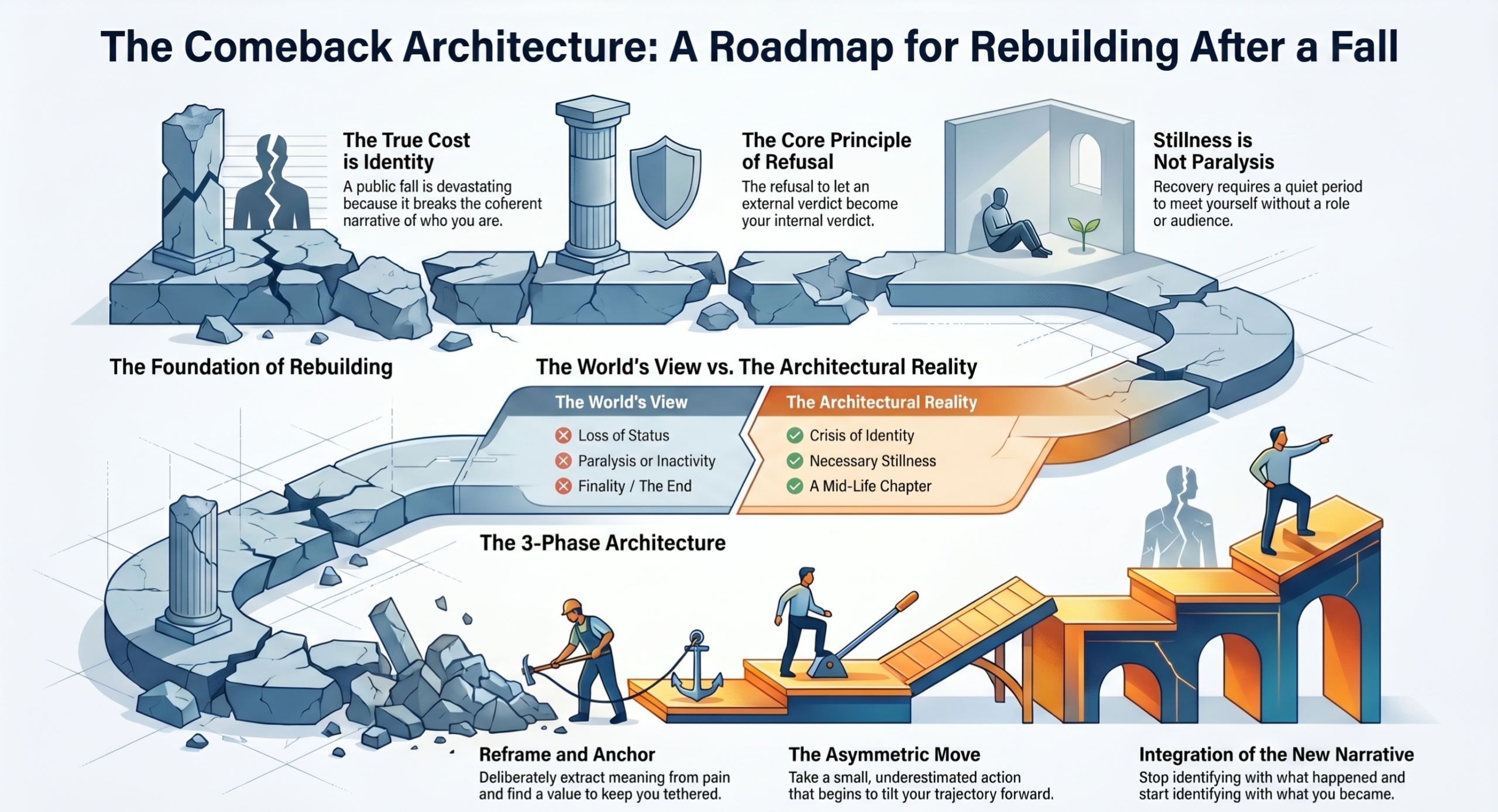
It is something else. Something more interior. Something I have started calling Comeback Architecture – the invisible internal structure that makes rebuilding not just possible, but permanent.
The Fall Is Never Just Professional
Before we talk about the architecture, we need to talk about what a fall actually costs.
Because most people misunderstand it. They think a public fall is about losing a position, or money, or status. And yes, it is that. But the deeper cost is identity.
When Kiran Mazumdar-Shaw’s first business venture struggled in its early years and she was rejected by virtually every bank, every institution, every person she approached for funding – the loss was not just financial. It was the daily erosion of believing she had the right to occupy the space she was trying to occupy. A woman. In science. In entrepreneurship. In India. In 1978. Every door that closed was not just a logistical setback. It was a message.
You do not belong here.
When Steve Jobs was removed from Apple in 1985 – the company he had co-founded, the company that was his entire identity – he did not just lose a job. He lost the story he had been telling himself about who he was. He described the years that followed as devastating. Not difficult. Devastating.
When Sanjay Dutt was sentenced to prison in 2013, after years of legal battles that had already shredded his career trajectory, what collapsed was not just his filmography. It was the coherent narrative of his life. The son of Sunil Dutt. The hero. The survivor. All of it suddenly rewritten by a single judgment.
When Malala Yousafzai was shot in the head on a school bus at fifteen years old by a gunman who believed her voice was dangerous – the fall was existential. It was not metaphorical. It was a bullet.
Different falls. Different lives. Different corners of the world. But the same interior experience: the self, suddenly unmoored. The story, suddenly broken.
This is what makes comebacks so much harder than most people imagine. You are not just rebuilding a career. You are rebuilding a self.
The Five Phases of Comeback Architecture
After studying stories of rebuilding across decades, cultures, and contexts – athletes, entrepreneurs, politicians, artists, ordinary people who fell quietly and rose quietly – I have come to believe that every genuine comeback moves through five distinct phases. Not always cleanly. Not always in order. But always through these territories.
Phase 1: The Stillness
Every rebuilt life begins with a period that looks, from the outside, like paralysis.
It is not.
After Jobs was ousted from Apple, he did not immediately launch NeXT and Pixar. He wandered. He travelled. He sat with the wreckage. He said years later that getting fired was the best thing that ever happened to him, but he could not have said that then. Then, it just felt like loss.
After Malala was shot, she spent months in hospitals across Pakistan and the UK. She was not plotting her next move. She was learning to walk. Learning to speak. Learning to exist in a body that had nearly stopped existing.
This stillness is not wasted time. It is the most important phase in the entire architecture. Because it is here – in the discomfort of having nothing to perform, no role to play, no audience to face – that a person is finally forced to meet themselves.
The people who rush through this phase, who perform recovery before they have actually recovered, who post the comeback story before they have written it in their own interior – they fall again. Sometimes harder.
The people who sit with it… they build differently.
Phase 2: The Reframe
This is where the architecture actually begins.
A reframe is not optimism. It is not pretending the fall did not happen, or that it was secretly a blessing in disguise. A reframe is something much more surgical: it is the deliberate choice to extract meaning from an experience that initially offers none.
Consider Sudha Murthy. Before she became one of India’s most beloved authors and philanthropists, she applied for a job at TATA Engineering. She saw a notice that said the company was not accepting women candidates. She wrote directly to J.R.D. Tata – a letter that was bold to the point of audacity. She got the job. But the point is not the outcome. The point is what she did with the insult. She did not let it define her ceiling. She let it clarify her spine.
Or consider Harland Sanders – Colonel Sanders – who at the age of sixty-two, after his restaurant was shut down due to a new highway bypassing his location, found himself with little savings and a recipe for fried chicken. He drove across America, sleeping in his car, approaching restaurants personally. He was rejected over a thousand times. One thousand. He reframed that number not as evidence of failure but as evidence of persistence. He was sixty-five when the first Kentucky Fried Chicken franchise opened.
The reframe is the moment when a person stops asking why did this happen to me and starts asking what is this making possible that was not possible before?
That question does not erase the pain. But it redirects the energy.
Phase 3: The Anchor
Every person who has rebuilt after a devastating fall has had at least one anchor — a relationship, a value, a practice, or a creative outlet — that kept them tethered to themselves during the rebuilding.
For Sanjay Dutt, it was his family and a discipline he found in prison that he had never found outside it. For the first time in decades, stripped of every distraction, he encountered himself. He came out of prison different. Not because prison was good. But because the anchor held.
For Sundar Pichai – who grew up in Chennai with his family of four sharing a two-room apartment, who failed to get into IIT, who faced years of uncertainty before building one of the most consequential careers in technology – the anchor was never status. It was curiosity. An obsessive, almost childlike curiosity about how things worked. That curiosity could not be taken away by a rejection letter or a missed opportunity. It survived every fall.
For the domestic worker in Mumbai who loses her primary employer and rebuilds from scratch – through skill, through reputation, through the quiet dignity of showing up – the anchor is often something even simpler. Pride in her work. The identity of being someone who does not cut corners. That invisible standard she holds herself to when no one is watching.
The anchor does not have to be grand. It has to be real.
Without it, rebuilding becomes performance. And performance, without roots, collapses again at the first pressure point.
Phase 4: The Asymmetric Move
This is the phase most people miss when they study comebacks. Because from the outside, it often looks unremarkable. It rarely looks like a comeback at all.
The asymmetric move is a small, deliberate, often underestimated action that begins to tilt the trajectory.
When J.K. Rowling was a single mother on welfare, recently divorced, clinically depressed, and writing in Edinburgh cafés because her flat was too cold – the asymmetric move was finishing the manuscript. That was it. Not publishing it. Not getting famous. Just finishing it. In conditions that made finishing feel impossible. That one stubborn act of completion changed everything downstream.
When Irrfan Khan was diagnosed with a neuroendocrine tumor in 2018, he did something quietly radical. He wrote publicly about his experience – not to perform vulnerability, but to genuinely process it and share it. He continued working. He returned to India. He delivered some of the most nuanced performances of his career in the months before his death. The asymmetric move was choosing depth over withdrawal at the moment when most people would have retreated entirely.
When a mid-level manager in a fintech company loses her role after a restructuring and sends one carefully crafted letter to one person she genuinely admires – not ten generic LinkedIn requests but one real, human, specific note – and gets a coffee meeting that changes her direction… that is an asymmetric move.
It is small. It is precise. And it disproportionately changes what comes next.
Phase 5: The New Narrative
The final phase of comeback architecture is not a triumphant announcement. It is quieter than that.
It is the moment when a person stops identifying primarily with what happened to them and starts identifying with what they became because of it.
Kiran Mazumdar-Shaw does not tell the story of her early rejections as a tragedy. She tells it as evidence of the environment she was operating in and proof that the environment was wrong, not her. Biocon is now one of India’s largest biopharmaceutical companies. The banks that refused her are now lining up to associate with her name.
Malala does not perform survivorship. She builds. The Malala Fund. The Oxford degree. The book. The global voice. Each one not a memorial to what happened to her but an expansion of what she always was.
And this is what the new narrative really means. It is not spin. It is not rebranding. It is the slow, honest process of integrating an experience – even a terrible one – into a larger story that is still moving forward.
The fall becomes a chapter. Not the final one. Not the defining one. A chapter.
The One Thing Every Comeback Has in Common
I promised you this. And I will not bury it.
After everything – the stillness, the reframe, the anchor, the asymmetric move, the new narrative – there is one thing that every genuine, lasting comeback has in common.
Not resilience. That word has been so overused it has lost its edges.
Not grit. Not hustle. Not mindset.
It is refusal.
A very specific kind of refusal.
The refusal to let the external verdict become the internal verdict.
Kiran Mazumdar-Shaw refused to let institutional rejection become personal inadequacy.
Jobs refused to let being fired from Apple become the final word on what he was capable of building.
Malala refused to let a bullet become a silencer.
Colonel Sanders refused to let one thousand rejections become confirmation that he had nothing worth offering.
The domestic worker who rebuilds her client base refuses to let one family’s dismissal become the story of her worth.
The manager who lost her role refuses to let a restructuring become an obituary for her career.
Every single one of them, across different centuries, different cultures, different geographies, different scales of fall – they all did this one thing. They maintained a separation between what the world said about them and what they knew, somewhere deep and stubborn, to be true about themselves.
That interior separation is the foundation of comeback architecture. Everything else is built on top of it.
What This Means for You
If you are reading this in the middle of your own fall – and some of you are, I know this – I want to say something directly.
The noise right now is not the truth.
The version of you that exists in other people’s conversations, in performance ratings, in closed-door discussions you cannot access, in the narrative that has formed faster than the facts – that version is not the complete version.
You are more than the worst chapter.
But I will not lie to you either. The architecture takes time. The stillness is uncomfortable. The reframe does not come easily. The anchor sometimes feels like the only thing keeping you from disappearing entirely. The asymmetric move often happens in conditions that feel humiliating rather than heroic.
And the new narrative… the new narrative is written slowly. Word by word. Day by day. Action by action.
But it gets written.
Every person in this piece built something after. Something real. Something that the fall – as devastating as it was – actually made possible by clearing the ground.
Your ground is being cleared right now.
The question is only what you choose to build.

Dr. Arpita Sen holds a bachelor’s degree in Dental Surgery (BDS) from YMT Dental College and Hospital, Navi Mumbai. She also holds an MBA in Human Resources from Narsee Monjee Institute of Management Studies (NMIMS), Mumbai, where she graduated as a double gold medallist. She is the co-author of Not a Rat Race: Success Mantras of World Athletes (2023), and Winning as Husband and Wife: Decoding the Success Mantras of Marriage (2026), co-written with Abhirup. She currently leads Learning, Organization Development, DEI, Culture, Talent and HR Strategy at a multinational organization. She writes on growth, leadership, and the future of work in her blogs, mindofhr.com and hustlerguru.com, and has been featured across several speaking platforms, podcasts and panel discussions. In her free time, she enjoys travelling, reading novels, singing and performing classical dance. She can be reached on Instagram at @authorarpitasen and on LinkedIn
Read her books:
Not a Rat Race: Success Mantras of World Atheletes
Winning as Husband and Wife: Decoding the Success Mantras of Marriage